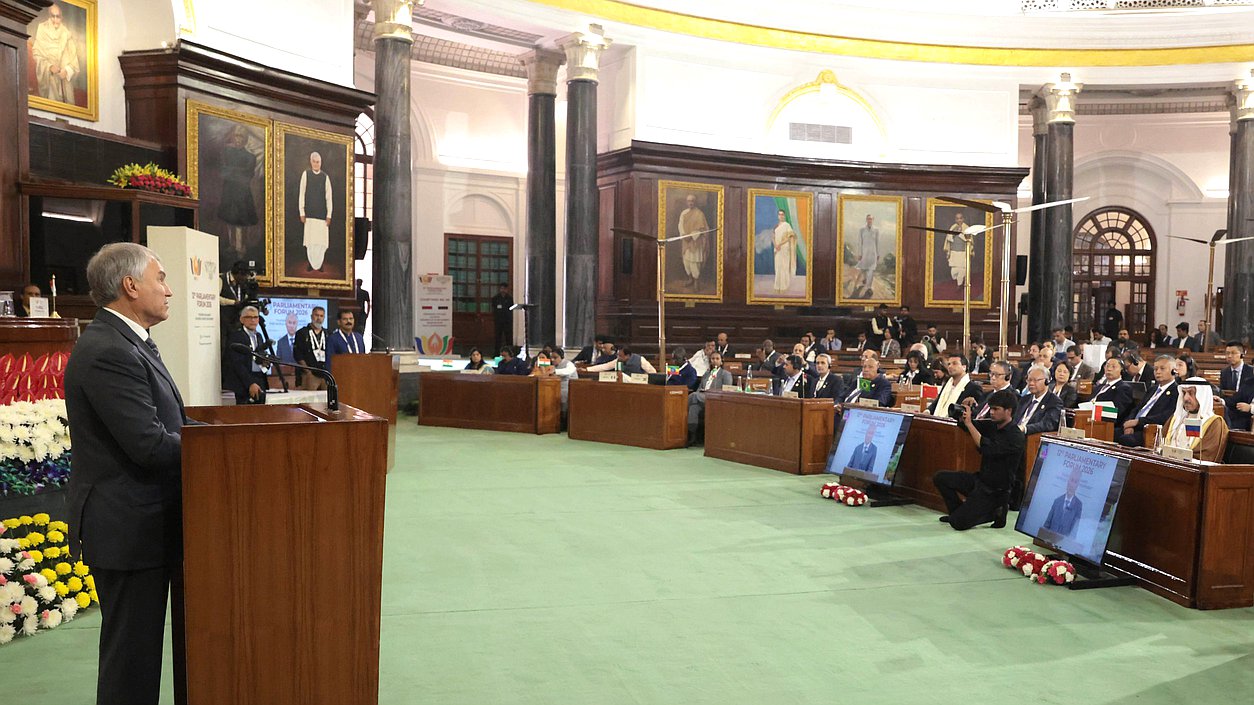
“Dear colleagues!
Let me welcome all of you at the 12th BRICS Forum.
First of all, let me express
words of gratitude to our Indian friends for their hospitality, high level of organization. And, of course, in this regard, I would like to say thank you to the Speaker Om Birla. Dear colleague, thank you very much for your deep attention
to all of us, for meetings, preparations, we feel that. The atmosphere at the Forum’s
events is very friendly, camaraderie; we see that many like-minded people have
gathered there.
We represent the countries
with different political systems, economic models and traditions. But we are
united on the issues of building a multipolar world, respecting the different
approaches, national legislations, recognizing the right of each state to develop sovereignly.
BRICS in its 20-years
history became one of the key pillars of the shaping multipolar world, a just
world order, based on the principles of equality and mutually beneficial
cooperation.
The union has turned into
one of the largest economic centers which shows the interests of the world
majority. The internal trade at the union reached almost 1.2 trillion dollars. Member
states are involved in almost a quarter of global export. BRICS has the biggest
part in the global GDP – almost 40%.
It is important to note that
since the creation of the union our countries steadily upheld the principles of openness, mutual respect and trust, and absence of double standards. Nowadays more and more states
support these
principles. They choose the path of equal dialogue and effective cooperation in the interests of people.
Colleagues, the system of international relations is undergoing a transformation. It is going through all
those processes and that means that the architecture of modern inter-parliamentary
diplomacy is also changing. Leaders of our states in their declaration after
the BRICS Summit held in New Delhi on September 12 and 13, 2026, noted the important role of the parliamentary dialogue for developing cooperation and deepening mutual understanding between BRICS nations. It obliges us a lot. We
should find common answers together to address the global challenges our countries
are facing.
The parliamentary forums
that are held annually, as well as the Forum we attend today, are a good
opportunity to exchange experience and best legislative practices not only on issues that we have already discussed but on other issues too. For us, it is a good opportunity to use a bilateral form of dialogue as well. BRICS provides us
all these opportunities, and we plan to hold meetings on its sidelines.
We propose to interact more
active at the level of the relevant committees of the BRICS parliaments. This
potential is not exhausted, we should definitely use it, and take into account
the fact that our countries have their proposals on issues. And at the level of the relevant committees, we could exchange both the legislative approaches to address issues and developments as well.
The agenda of our
inter-parliamentary cooperation includes not only issues related to strengthening national sovereignty, but also issues related to enhancing security,
improving the quality of people’s lives, developing artificial intelligence.
Speaking about modern technologies and the speed of their progress, it is
important to adapt national legislations to changing conditions.
Artificial intelligence
brings not only opportunities but also modern challenges. We should not only remember
that but also realize that. And we should do our best to make artificial intelligence
serve people. We should avoid such situations when artificial intelligence rules
the humanity. This is dangerous and we should prevent it in advance and do
everything possible to enshrine that in legislations not only in our countries
but also in such unions, as BRICS, the United Nations.
If you support, we propose
to create within the BRICS parliamentary dimension an expert council which can
include relevant AI specialists from our countries. This would help exchanging
the best legislative practices.
Relations between our
countries within the BRICS framework are a good example of how sovereign states
cooperate on mutually beneficial terms improving their economies and the well-being of people. Within the framework of the parliamentary dimension, we
should use all the opportunities to make our own contribution to make our union
more effective.
Thank you for your
attention.”